This site is intended only for UK patients who have been prescribed Fasenra (benralizumab) for Severe Eosinophilic Asthma, or their caregiver

The Patient Information Leaflet for Fasenra is available here

This site is intended only for UK patients who have been prescribed Fasenra (benralizumab) for Severe Eosinophilic Asthma, or their caregiver

The Patient Information Leaflet for Fasenra is available here

  • Home
  • Learn more about FASENRA®
  • Help with self-administration
  • Helpful resources
  • Home
  • Learn more about FASENRA®
  • Help with self-administration
  • Helpful resources

LEARN MORE ABOUT EOSINOPHILIC ASTHMA AND FASENRA®

  • Your Fasenra prescription
  • Dosing Schedule
  • How to use Fasenra
  • Potential Side Effects

WHAT IS EOSINOPHILIC ASTHMA?

The majority of patients with severe asthma have eosinophilic airway inflammation.

This means their asthma is caused by high numbers of a type of white blood cells called eosinophils.
This can be checked by blood or sputum tests.

Elevated eosinophil levels cause inflammation and are associated with the cause and severity of both asthma and asthma exacerbations.

Eosinophil cells in the lungs

Severe asthma attacks

More harm to the lungs

WHY HAS YOUR DOCTOR PRESCRIBED FASENRA® FOR YOU?

Fasenra® is an anti-eosinophil treatment that directly targets eosinophils, helping your body to eliminate them from your blood and lungs resulting in a near complete depletion.

This may reduce the number of asthma attacks you have, help you to breathe better and decrease your asthma symptoms.

It's important to keep taking any other asthma treatment (inhalers/tablets) your doctor may have prescribed for you.

If you are taking 'oral corticosteroids', using Fasenra® may also allow you to reduce the daily dose needed to control your asthma or stop taking them completely.You should follow your doctor’s advice on this.

back to top

DOSING SCHEDULE

The first 3 doses are injected every four weeks and then subsequent doses are injected every eight weeks.
Connect360 helps you to use the Fasenra® device best suited to you at a place that is convenient to you.

THE FIRST YEAR OF TREATMENT WITH FASENRA®

If you cannot make your Fasenra® appointment or have missed a dose of Fasenra®: If you have missed a dose of Fasenra contact your doctor or nurse as soon as possible.

Stopping treatment with Fasenra®: do not stop treatment with Fasenra® unless your doctor advises you to. Interrupting or stopping treatment with Fasenra® may cause your asthma symptoms to worsen.

back to top

HOW TO USE FASENRA®?

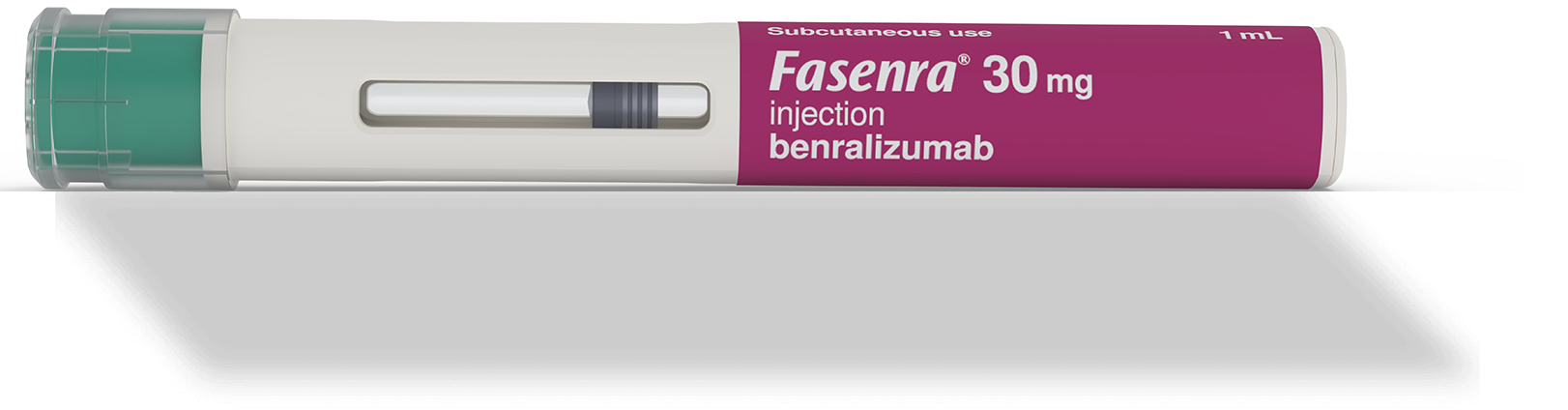
Fasenra® can be injected either in a hospital outpatient clinic or, after training, by you or a caregiver in your preferred location using a pre-filled pen:

A PRE-FILLED PEN

Watch instruction video

OR A PRE-FILLED SYRINGE

Before using Fasenra, leave the carton out of the fridge for about 30 minutes to allow the pre-filled pen to reach room temperature.

back to top

ARE THERE ANY SIDE EFFECTS WITH FASENRA® TREATMENT?


As with all medicines, it is possible that you could experience some side effects with Fasenra® treatment but not everyone does.

Common side effects, which may affect up to 1 in 10 asthma patients, include:

  • Headache
  • Pharyngitis (sore throat)
  • Pyrexia (high temperature, fever)
  • Injection site reaction (e.g. pain, redness, itching, swelling near where the injection was given)

Some people may develop allergic reactions.

These reactions are common (they can affect up to 1 in 10 people).

Symptoms usually include:

  • Hives
  • Rash

If you experience any side effects, please talk to your doctor, nurse, or pharmacist.

In some rare cases, patients may experience a severe allergic reaction known as anaphylaxis. However, the frequency cannot be determined by the available data. The symptoms usually include:

  • Swelling of your face, tongue, or mouth
  • Breathing problems
  • Fainting, dizziness, feeling lightheaded (due to a drop in blood pressure)

Seek medical attention immediately if you think you may be having an allergic reaction. Such reactions may happen within hours or days after the injection.

Please refer to the full Fasenra® Patient Information Leaflet for more information which can be found at: https://www.medicines.org.uk/emc/product/10559/pil

If you get any side effects, talk to your doctor, pharmacist or nurse. This includes any possible side effects not listed in the package leaflet. You can also report side effects directly via the Yellow Card Scheme at: www.mhra.gov.uk/yellowcard. By reporting side effects, you can help provide more information on the safety of this medicine.

back to top

STORING YOUR FASENRA® MEDICATION

14DAYS TO USE AFTER REMOVAL FROM REFRIGERATOR

STORING YOUR FASENRA® MEDICATION

If you receive your Fasenra® injections at home, either by self-administration or by a nurse coming to your home please make sure you store your Fasenra® in a refrigerator (2°C to 8°C) ideally on the middle shelf away from the back and sides.

After removal from the refrigerator, Fasenra® must be used within 14 days regardless of whether or not it is returned to the fridge. If it is not used within 14 days of first being removed from the fridge it should be discarded, please ask your pharmacist how to discard medicines you no longer use.

Also, please store it in the original package to protect it from light. Do not shake, freeze or expose to heat.


All medicines should be stored out of the sight and reach of children.

Visit helpful resources

back to top

back to top

GB-70746 | DOP: January 2026

Fasenra® (benralizumab) Connect 360, an AstraZeneca UK developed and funded website

The content on this website is intended only for UK patients who have been prescribed Fasenra (benralizumab) for Severe Eosinophilic Asthma, or their caregiver

I am not a UK patient who has been prescribed Fasenra, or their caregiver
  • Legal notice and terms of use
  • |
  • Contact Us
  • |
  • Privacy Policy
  • |
  • Cookie Notice

Reporting of side effects

If you get any side effects, talk to your doctor, pharmacist or nurse. This includes any possible side effects not listed in the package leaflet.

You can also report side effects directly via the Yellow Card Scheme at: www.mhra.gov.uk/yellowcard.

By reporting side effects, you can help provide more information on the safety of this medicine.

This is a non-promotional website developed and funded by AstraZeneca.


This site is intended to complement, not replace the 'Instructions for Use' and 'Patient Information Leaflet' (found in your medicine pack). Refer to these materials for additional important information.


If you have any questions or concerns about your treatment, you should always talk to your healthcare team.


FASENRA® is a registered trademark of the AstraZeneca group of companies. ©2025 AstraZeneca All rights reserved. GB-70406 I September 2025